
Tracing the Footprints: Dr Fareed-ud-Din Qadri’s Spiritual Expedition: Dr. Farhat Abbas Shah
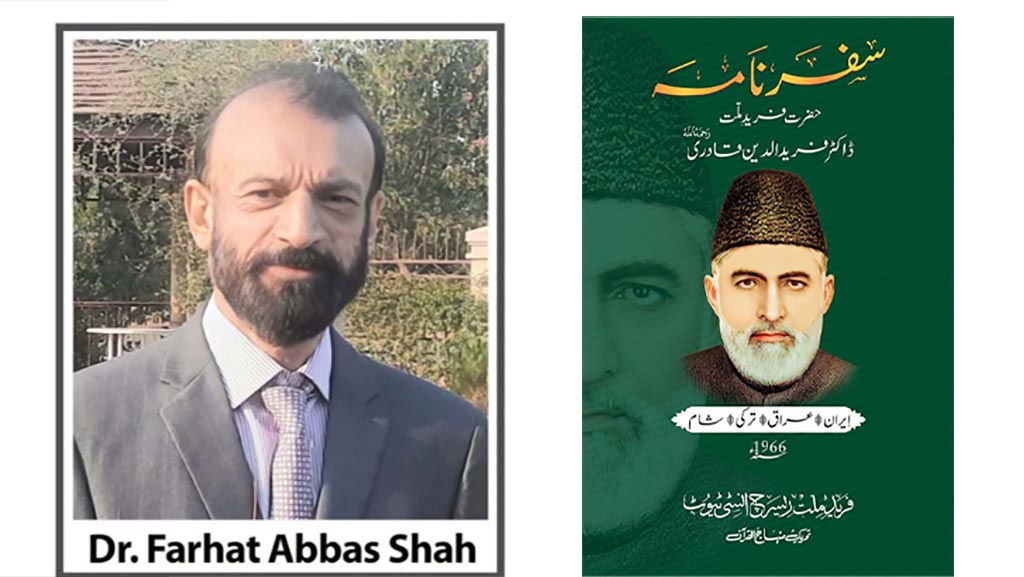
Travel literature at its noblest is not an inventory of distances but a discourse of discernment, where the outer itinerary mirrors the inner ascent and geography loosens into gnosis. In the age of mechanical movement and hurried exploration, very few writers transform their journeys into acts of illumination. Dr. Fareed-ud-Din Qadri’s travelogue belongs to that rare category where travel ceases to be external displacement and becomes an inward pilgrimage. What emerges is not mere reportage but a tapestry of spiritual intellection: cities disclosed as parables, shrines approached as living texts, and encounters rendered with the humility of one who knows that the true destination is neither latitude nor longitude but the heart restored to clarity. His narrative is not a chronicle of motion but a tapestry of revelation woven with threads of faith, scholarship, and inward yearning. In every page, there breathes the fragrance of remembrance, the contemplative tone of a heart that moves through countries but converses with eternity.
The book’s architecture is deliberate: a secret eastward turning in Iran, a descent into the Iraqi heartland of memory, a passage through Anatolia’s thresholds, and a final deepening in the Syrian basin of saints and scholars. The prose is formal yet fragrant, the argumentation academic yet alive. It invites the reader to move at the pace of reverence, to adopt the contemplative gait by which meanings arrive unforced. Above all, it insists on the unity of knowledge scripture and skyline, chronicle and calligraphy, the dome and the doctrine each amplifying the other until scholarship ripens into insight.
This design reflects the temperament of the writer himself. Dr. Fareed-ud-Din Qadri writes as a scholar of tradition who trusts the intuition of the polished heart, as a literary craftsman who measures cadence, and as a traveler who knows that decorum is a way of thinking. There is a classical poise in his sentences: clauses balanced like arches, metaphors glazed like tiles, and transitions handled with the restraint of someone who has learned that the sacred does not shout. He is generous to texts and people alike, quick to praise, slow to judge, and never tempted to trivialize a place by reducing it to a photographable fact. His adab is his method; his method yields meaning.
Iran becomes the first unveiling, the land of poets, mystics, and saints. His secret visit unfolds with an almost cinematic quietness: Zahidan’s dry winds whispering of history, Mashhad’s golden domes gleaming with devotion, Nishapur shimmering under the echo of Umar Khayyam’s quatrains and Attar’s fragrance of annihilation. The author observes every city with the gaze of a lover who reads both script and silence. In Nishapur he stands before the graves of poets, and his pen trembles with reverence for the paradox of creation the mortal word aspiring to immortality. From there to Bistam, he follows the invisible footsteps of Bayazid Bistami, whose cry “Subhānī, mā aʿẓama sha’nī” still vibrates through Persian dust. The writer does not merely recount these shrines; he re-awakens their spirit. His reflections reveal a deep acquaintance with tasawwuf: he interprets Bayazid’s ecstasy as the metaphysical dissolution of the self before the overwhelming vision of the Real.
Khurqan and Semnan, though smaller on the map, become vast within the author’s meditation. He perceives the modest shrines as metaphors for humility the state that precedes revelation. In Tehran he observes modernity struggling with its own shadow, yet even amid the steel and noise, he hears the faint heartbeat of the old Persian soul. The shrines of Qum and Isfahan turn his writing toward metaphysical aesthetics: he reads the calligraphy on domes as the silent speech of angels, geometry as an act of worship, and architecture as theology materialized. The blue tiles of Isfahan, shimmering in the morning sun, appear to him as frozen music each arabesque a remembrance of the Infinite rhythm. In Shiraz, the land of Hafez, Saʿdi, and wine-of-spirit, his tone becomes lyrical. He meditates before the poets’ tombs, realizing that true intoxication lies not in the goblet but in divine nearness. The shrine of Shah Chiragh and the gardens of Shiraz merge for him into one allegory: that the fragrance of love survives every century because it emanates from the eternal Beloved.
From Iran he proceeds to Iraq, the cradle of civilization and the crucible of saints. Basra greets him with its riverine melancholy, once the home of Rabia al-Basri, whose cry of pure love still ripples through the centuries. Dr. Fareed-ud-Din Qadri recalls her doctrine of loving God for His own sake, finding in it the earliest articulation of selfless devotion. Baghdad follows majestic yet mournful where every street retains the echo of Junayd, Shibli, and Ghazali. Standing before the Maqbara-e-Ghazali, the author writes as if conversing with the ghost of orthodoxy purified by illumination. He interprets Ghazali’s intellectual pilgrimage as the archetype of all genuine seekers: knowledge culminating in surrender, logic dissolving into light. Baghdad in his prose becomes both a city and a metaphor for human destiny the rise and fall of intellect until it kneels before faith.
Karbala, Najaf, and Kufa unfold as the heart of his journey. The language turns luminous, reverent, and restrained. The author writes of Karbala not merely as an event of history but as the eternal paradigm of moral consciousness. He stands before the shrine of Imam Hussain and feels that every tear shed there refines the soul’s mirror. Najaf’s sanctity, Kufa’s quiet, and the scholarly aura of Imam Ali’s mausoleum stir in him a philosophical dialogue between courage and compassion, reason and revelation. In Samarra and Mosul, he finds the memory of the Ahl-e-Bayt etched into the very dust; in Nusaybin, he writes of the early Christian mystics who shared the same longing for transcendence. The spiritual inclusivity of his gaze reminds the reader that sanctity knows no border; light travels beyond sects.
Turkey forms the third turning, the country of fusions. Istanbul opens grandly Āyā Sofyā read as a palimpsest where prayer and history touch without erasing, and the Eyüp Sultan precincts tenderly described at the grave of Abū Ayyūb al-Anṣārī (R.A.), the beloved host of the Prophet in Madinah. Dr. Fareed-ud-Din Qadri reads its vast silence as a dialogue between the cross and the crescent. At the shrine of Hazrat Ayub Ansari, his tone grows tender; he feels the continuity of companionship between the Prophet’s age and the present. His words linger on the idea that proximity to the Prophet is not limited by time or space but by the depth of love within the heart.
From there, he journeys to Konya the axis of his Turkish experience and the spiritual
centre of the Mevlevi order. Before the resting place of Maulana Rumi, his prose
reaches lyrical ecstasy. He interprets Rumi not as a poet alone but as a metaphysical
revolution a turning of being itself toward divine rhythm. The whirling dervish
becomes for him the visible metaphor of the universe’s obedience to divine will.
His description of the samaa (spiritual dance) blends philosophy and devotion: the
circular motion of the dancer mirrors the cosmic law where all creation revolves
around the One. The author’s language here acquires an almost musical resonance;
his sentences spin gracefully, echoing the rhythm of Rumi’s verse and the cadence
of love unending. In Antakya, the ancient Antioch, he observes the confluence of
faiths with the balanced compassion of a true scholar. He notes how Islam inherited,
purified, and extended the Abrahamic spirit. His reflections on the coexistence
of mosques and churches reveal an acute historical consciousness a reminder that
civilizations, like souls, thrive on dialogue, not division.
Syria is the culminating cadence, quieter and more interior. Jabla (Jableh) appears
first, and the author deftly evokes Ibrāhīm ibn Adham princely renunciant whose
name the town still breathes. The writing here acquires a contemplative severity:
poverty re-glossed as freedom, anonymity as the first real title. Hama enters with
its noriahs those patient waterwheels turning time into service and the image becomes
a metaphor for dhikr performed by wood and river. Damascus is then allowed its majesty.
The Umayyad Mosque is described with scholastic exactitude and lyric tenderness
the head of Yahya (A.S.) venerated within, the noble memory of Sayyidunā Bilāl (R.A.)
felt in the ambient piety, the nearby maqbara of Ṣalāḥ al-Dīn al-Ayyūbī (R.A.) approached
with the decorum owed to a liberator who understood limits. The text does not forget
Sayyida Zaynab (A.S.) on the city’s edge: a sanctuary of steadfastness where grief
is cultivated into gratitude. From Damascus the author ascends toward Maqām al-Arbaʿīn
on Jabal Qāsiyūn, rendering it as the high classroom of silence forty saints a cipher
for constancy, the overlook a diagram of proportion between world and watcher. And
he concludes in al-Mazah the village just outside Damascus you specified attentive
to its graves of ṣaḥābah and awliyā’. The tone here is properly hushed: no catalogue,
only recognition that some places teach by mere air, that sanctity sometimes survives
in the simplicity of an unadvertised cemetery.
Across these sections, certain intellectual threads bind the book into an argument. First, the unity of knowledge: the author makes architecture legible as a doctrine the iwan as an aperture of mercy, the muqarnas as a descent of generosity, the calligraphic band as a ribbon binding law to love. Second, the ethics of visitation: he understands ziyārah not as touristic access but as apprenticeship to a place’s prayer; comportment is part of comprehension. Third, the philosophy of time: Iranian gardens, Iraqi courtyards, Turkish thresholds, and Syrian hills are not dated; they are layered, and the writer treats them as such knowing that certain hours of the day and certain months of the year instruct differently. The scholarship is sound and worn lightly. Citations are woven into cadence; Qur’anic echoes and Persian distiches come and go without ostentation, always in service of sense.
Across these sections, certain intellectual threads bind the book into an argument. First, the unity of knowledge: the author makes architecture legible as a doctrine the iwan as an aperture of mercy, the muqarnas as a descent of generosity, the calligraphic band as a ribbon binding law to love. Second, the ethics of visitation: he understands ziyārah not as touristic access but as apprenticeship to a place’s prayer; comportment is part of comprehension. Third, the philosophy of time: Iranian gardens, Iraqi courtyards, Turkish thresholds, and Syrian hills are not dated; they are layered, and the writer treats them as such knowing that certain hours of the day and certain months of the year instruct differently. The scholarship is sound and worn lightly. Citations are woven into cadence; Qur’anic echoes and Persian distiches come and go without ostentation, always in service of sense.
The book’s literary force derives from how it keeps sorrow and serenity in right relation. Where memory demands mourning (Karbala, Samarra), the author is unflinching but never theatrical; where grace invites delight (Shiraz, Konya), he is joyful but never careless. This moral proportion is the review’s most persuasive argument for the travelogue’s necessity in our crowded age: it models a reading practice in which the world is not consumed but contemplated, not used but understood. By giving places back their interiority, Dr. Qadri returns readers to theirs.
Stylistically, the prose maintains an elevated, formal register without stiffness.
The writer’s cadences accept ornament only where ornament is argument. He allows
detail to do the teaching: the way dust lifts in a bastī courtyard at noon; the
particular timbre of adhan above the Tigris; the reflective hush before a lattice
at Qom; the nearly mathematical crispness of an Isfahani facade; the interior twilight
at Āyā Sofyā; the breath-tightening ascent up Qāsiyūn. These specifics are governed
by a larger metaphysic: tawḥīd expressed as proportion, ihsān sounded as courtesy,
yaqīn practiced as patience. The tasawwuf here is not abstraction but method purification
of motive, concentration of gaze, rectification of posture before the Real and before
His friends.
Beyond the textual beauty, the book achieves philosophical cohesion. It portrays
the unity of existence not as abstract doctrine but as lived experience. Dr. Fareed-ud-Din
Qadri experiences tawḥīd in every shrine he visits seeing multiplicity as manifestation,
not contradiction. His reflection that “in every face I saw the Face that is One”
encapsulates his metaphysical stance. The journey through diverse lands becomes
a demonstration of that unity: different soils, one fragrance; different languages,
one invocation; different tombs, one Presence.
By the time the reader reaches the end, a sense of inward completion arises. The journey that began as outward travel ends as intellectual and spiritual transformation. The author, returning from distant shrines, seems to have discovered that the truest shrine resides within the purified heart. His closing reflections breathe gratitude and awe: the awareness that the Beloved he sought in distant lands had been walking beside him all along.
Thus, Dr. Fareed-ud-Din Qadri’s travelogue stands as a luminous contribution to modern Islamic letters a synthesis of literature, tasawwuf, and reflective philosophy. It revives the classical tradition of travel as spiritual metaphor while employing the precision of contemporary prose. It speaks to scholars through its insight, to poets through its beauty, and to seekers through its sincerity. Reading it is not merely following an itinerary; it is accompanying a sage through the vast landscapes of remembrance. Long after the last page, one feels the stillness of domes, the perfume of shrines, and the music of the soul’s unending journey.








Comments