
Debt — A Major Obstacle to Economic Stability: Prof. Dr. Hussain Mohi-ud-Din Qadri
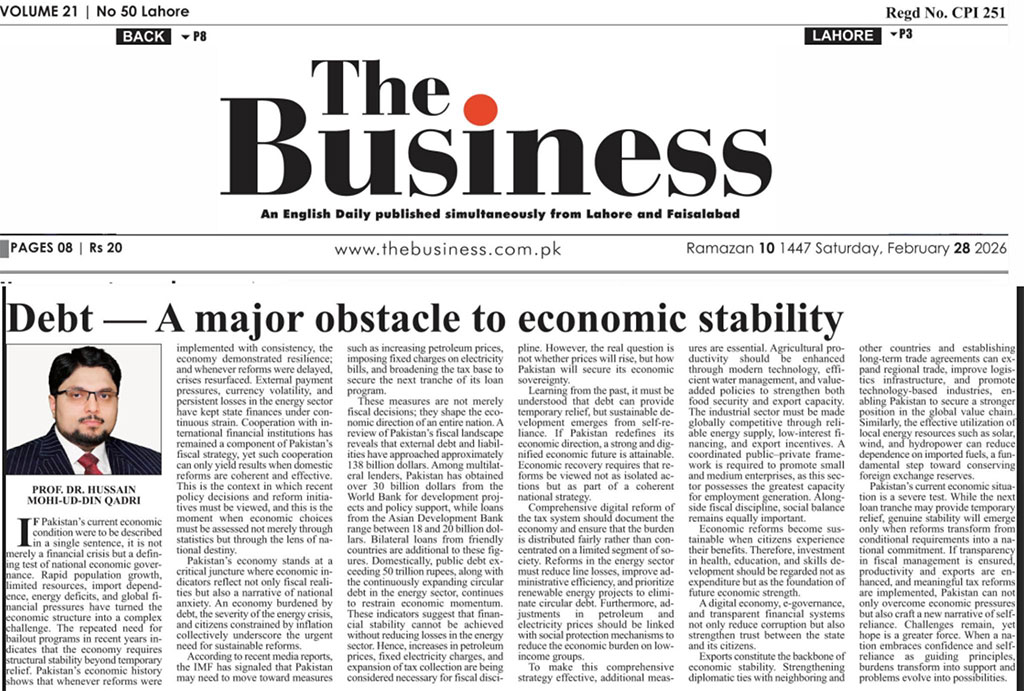
If Pakistan’s current economic condition were to be described in a single sentence, it is not merely a financial crisis but a defining test of national economic governance. Rapid population growth, limited resources, import dependence, energy deficits, and global financial pressures have turned the economic structure into a complex challenge. The repeated need for bailout programs in recent years indicates that the economy requires structural stability beyond temporary relief. Pakistan’s economic history shows that whenever reforms were implemented with consistency, the economy demonstrated resilience; and whenever reforms were delayed, crises resurfaced. External payment pressures, currency volatility, and persistent losses in the energy sector have kept state finances under continuous strain. Cooperation with international financial institutions has remained a component of Pakistan’s fiscal strategy, yet such cooperation can only yield results when domestic reforms are coherent and effective. This is the context in which recent policy decisions and reform initiatives must be viewed, and this is the moment when economic choices must be assessed not merely through statistics but through the lens of national destiny.
Pakistan’s economy stands at a critical juncture where economic indicators reflect not only fiscal realities but also a narrative of national anxiety. An economy burdened by debt, the severity of the energy crisis, and citizens constrained by inflation collectively underscore the urgent need for sustainable reforms.
According to recent media reports, the IMF has signaled that Pakistan may need to move toward measures such as increasing petroleum prices, imposing fixed charges on electricity bills, and broadening the tax base to secure the next tranche of its loan program. These measures are not merely fiscal decisions; they shape the economic direction of an entire nation. A review of Pakistan’s fiscal landscape reveals that external debt and liabilities have approached approximately 138 billion dollars. Among multilateral lenders, Pakistan has obtained over 30 billion dollars from the World Bank for development projects and policy support, while loans from the Asian Development Bank range between 18 and 20 billion dollars. Bilateral loans from friendly countries are additional to these figures. Domestically, public debt exceeding 50 trillion rupees, along with the continuously expanding circular debt in the energy sector, continues to restrain economic momentum. These indicators suggest that financial stability cannot be achieved without reducing losses in the energy sector. Hence, increases in petroleum prices, fixed electricity charges, and expansion of tax collection are being considered necessary for fiscal discipline. However, the real question is not whether prices will rise, but how Pakistan will secure its economic sovereignty.
Learning from the past, it must be understood that debt can provide temporary relief, but sustainable development emerges from self-reliance. If Pakistan redefines its economic direction, a strong and dignified economic future is attainable. Economic recovery requires that reforms be viewed not as isolated actions but as part of a coherent national strategy. Comprehensive digital reform of the tax system should document the economy and ensure that the burden is distributed fairly rather than concentrated on a limited segment of society. Reforms in the energy sector must reduce line losses, improve administrative efficiency, and prioritize renewable energy projects to eliminate circular debt. Furthermore, adjustments in petroleum and electricity prices should be linked with social protection mechanisms to reduce the economic burden on low-income groups.
To make this comprehensive strategy effective, additional measures are essential. Agricultural productivity should be enhanced through modern technology, efficient water management, and value-added policies to strengthen both food security and export capacity. The industrial sector must be made globally competitive through reliable energy supply, low-interest financing, and export incentives. A coordinated public–private framework is required to promote small and medium enterprises, as this sector possesses the greatest capacity for employment generation. Alongside fiscal discipline, social balance remains equally important. Economic reforms become sustainable when citizens experience their benefits. Therefore, investment in health, education, and skills development should be regarded not as expenditure but as the foundation of future economic strength. A digital economy, e-governance, and transparent financial systems not only reduce corruption but also strengthen trust between the state and its citizens.
Exports constitute the backbone of economic stability. Strengthening diplomatic ties with neighboring and other countries and establishing long-term trade agreements can expand regional trade, improve logistics infrastructure, and promote technology-based industries, enabling Pakistan to secure a stronger position in the global value chain. Similarly, the effective utilization of local energy resources such as solar, wind, and hydropower can reduce dependence on imported fuels, a fundamental step toward conserving foreign exchange reserves.
Pakistan’s current economic situation is a severe test. While the next loan tranche may provide temporary relief, genuine stability will emerge only when reforms transform from conditional requirements into a national commitment. If transparency in fiscal management is ensured, productivity and exports are enhanced, and meaningful tax reforms are implemented, Pakistan can not only overcome economic pressures but also craft a new narrative of self-reliance. Challenges remain, yet hope is a greater force. When a nation embraces confidence and self-reliance as guiding principles, burdens transform into support and problems evolve into possibilities.








Comments