
The Foundations of Sufism: A Journey into Quran and Sunnah
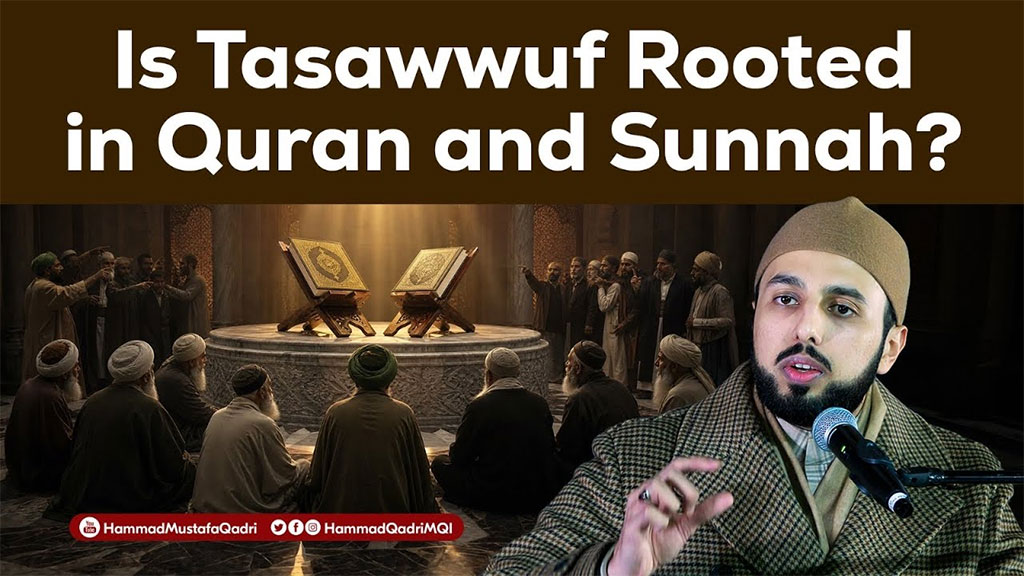
Sufism is found evidently and explicitly in principle in the Holy Quran and the Sunnah of the Holy Prophet (ﷺ). Shaykh Hammad Mustafa Al-madani Al-qadri
Someone who doubts the authenticity of the teachings of the Quran and Sunnah, they are challenging the primary sources upon which Islam is built upon. Shaykh Hammad Mustafa Al-qadri
Introduction:
In the contemporary discourse on Islamic spirituality, a recurring question arises: is Sufism (Tasawwuf) a later addition to the faith, or is it deeply embedded in its core? This blog explores the profound insights shared by Shaykh Hammad Mustafa al-Madani al-Qadri, who argues that Sufism is not an external concept but is rooted explicitly in the primary sources of Islam, the Holy Quran and the Sunnah. By examining the teachings of the Holy Prophet (ﷺ) and the practices of the earliest generations, we can uncover the authentic spiritual essence that defines Tasawwuf.
The Primacy of Quran and Sunnah:
The fundamental principles of Sufism are found evidently and explicitly within the Holy Quran and the Sunnah of the Prophet Muhammad (ﷺ). According to the teachings, doubting the veracity of these spiritual foundations is akin to challenging the very primary sources upon which the entire structure of Islam is built. Therefore, Tasawwuf is presented as an integral part of the faith's original message, rather than a separate or imported ideology.
The Sunnah of the Caliphs as a Guided Path:
Understanding the Sunnah requires a comprehensive view that includes not only the Prophet's (ﷺ) actions but also the Sunnah of the four rightly guided Caliphs. The Holy Prophet said:
فَعَلَيْكُمْ بِسُنَّتِي وَسُنَّةِ الْخُلَفَاءِ الْمَهْدِيِّينَ الرَّاشِدِينَ تَمَسَّكُوا بِهَا.
“So, hold fast to my Sunnah and the Sunnah of the rightly guided Caliphs.” (Abu Dawood, Al-sunan, Vol: 4, P: 200, Hadith# 4607)
The Prophet (ﷺ) explicitly stated that his Sunnah, as well as the traditions and practices of those who succeeded him, are obligatory for the believers. This broader definition of Sunnah provides a framework for understanding how spiritual practices were established and preserved by the immediate successors of the Prophet (ﷺ).
The Three Golden Generations: A Beacon of Light:
To determine the authenticity of any intellectual or spiritual tradition, one must look toward the “best generation” the companions (Sahaba), and the two generations that followed them. These three generations are described as a source of inspiration and a “beacon of light” for all Muslims. By studying their practices and teachings, scholars establish whether a particular tradition, such as Sufism, is a genuine reflection of the Islamic spirit or an unfounded innovation.
Establishing the Authenticity of Tasawwuf:
The principles of Sufism are not mere abstract theories; they are explicitly found in the practice and teachings of the Holy Prophet (ﷺ) and his companions. By looking into these early traditions, it becomes clear that the spiritual depth and ethical rigour associated with Sufism were lived realities during the earliest days of Islam. This historical and scriptural connection serves as the ultimate proof of Tasawwuf’s authenticity within the Islamic framework.
Conclusion:
Sufism is an authentic science of Islamic spirituality that draws its legitimacy directly from the Quran, the Prophet’s (ﷺ) life, and the guidance of the early Caliphs. It is a path illuminated by the “best generations”, serving as a bridge to the internal dimensions of faith. To embrace the principles of Tasawwuf is to honor the comprehensive legacy of the Sunnah, ensuring that the heart of Islam remains vibrant and deeply connected to its divine origins.
Dr. Muhammad Iqbal Chishti (Research Scholar)















Comments